

Picking out a new wood floor is exciting, but somewhere among all those beautiful samples, a quiet question tends to surface. Will it hold up to the dog's nails, the kids' toys, and the daily parade through the kitchen? This is exactly where a simple tool called the Janka hardness scale becomes your best friend. It takes the guesswork out of choosing hardwood flooring and turns durability into a number you can actually compare.
The good news is that you do not need to be a wood scientist to put it to use. Once you understand what the Janka number is telling you, you can walk into any showroom and shop with real confidence. As flooring experts, we love watching that moment when the whole idea suddenly clicks for someone. So let us walk through it together in plain, friendly language.
The number behind every wood floor
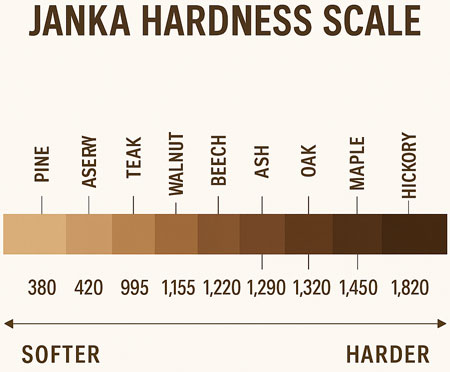
The Janka scale measures how well a particular wood species resists denting and general wear. Every type of wood, from soft pine to dense Brazilian walnut, earns its own score. The higher the number, the harder the wood, and the better it shrugs off everyday bumps and busy days. Think of it as a durability label that every wood floor quietly carries.
How the test actually works
The test itself is wonderfully straightforward and a little satisfying to picture. A small steel ball is pressed halfway into a plank of wood, and a machine records exactly how much force that takes. That force, measured in pounds, becomes the wood's Janka rating. More force required simply means a harder, more dent-resistant floor.
Making sense of the range
Numbers on their own can feel abstract, so a few familiar examples really help. Red oak, a longtime favorite, sits right around 1,290 and serves as the industry's everyday reference point. Softer choices like pine land well below that, while popular hardwood species such as hickory and maple climb higher, and exotic woods can soar past 3,000. Once you know where oak falls, every other floor starts to make sense.
Matching the scale to the way you live
Here is the part that matters most, because the ideal floor for your neighbor may be different from the ideal floor for you. A higher Janka rating is genuinely helpful in a lively home, yet it is only one piece of a bigger picture. Your daily routine, your rooms, and your personal style all deserve a seat at the table. There is no single right answer, only the floor that fits you best.
Choosing with your household in mind
If you share your home with big dogs, energetic kids, or steady foot traffic, leaning toward a harder species is a smart and reassuring move. Woods like hickory, maple, and white oak offer wonderful peace of mind in these active settings. For calmer spaces such as a guest room or a formal sitting area, a softer species can be a lovely and welcoming choice. Either way, the scale helps you choose on purpose rather than by chance.
When a softer floor still shines
A lower Janka number does not make a floor fragile, it simply means the wood gathers a bit more character over the years. Plenty of homeowners adore the lived-in warmth that softer species develop with time. And if you love the look of timber but want extra resilience near water or in a basement, luxury vinyl flooring delivers that wood appearance with remarkable staying power. It is proof that the right floor is about fit, not just a high score.
Your perfect floor is closer than you think
At H W Flooring, we have spent years helping neighbors across San Diego, Poway, Rancho Bernardo, Rancho Santa Fe, Del Mar, Escondido, and 4S Ranch find floors they love for years to come. If visiting our showroom is hard to squeeze in, we can shop at home with you and bring samples right to your door. We would be delighted to help you match the right Janka rating to your space and your style.


